
Engineering management of hatching egg storage
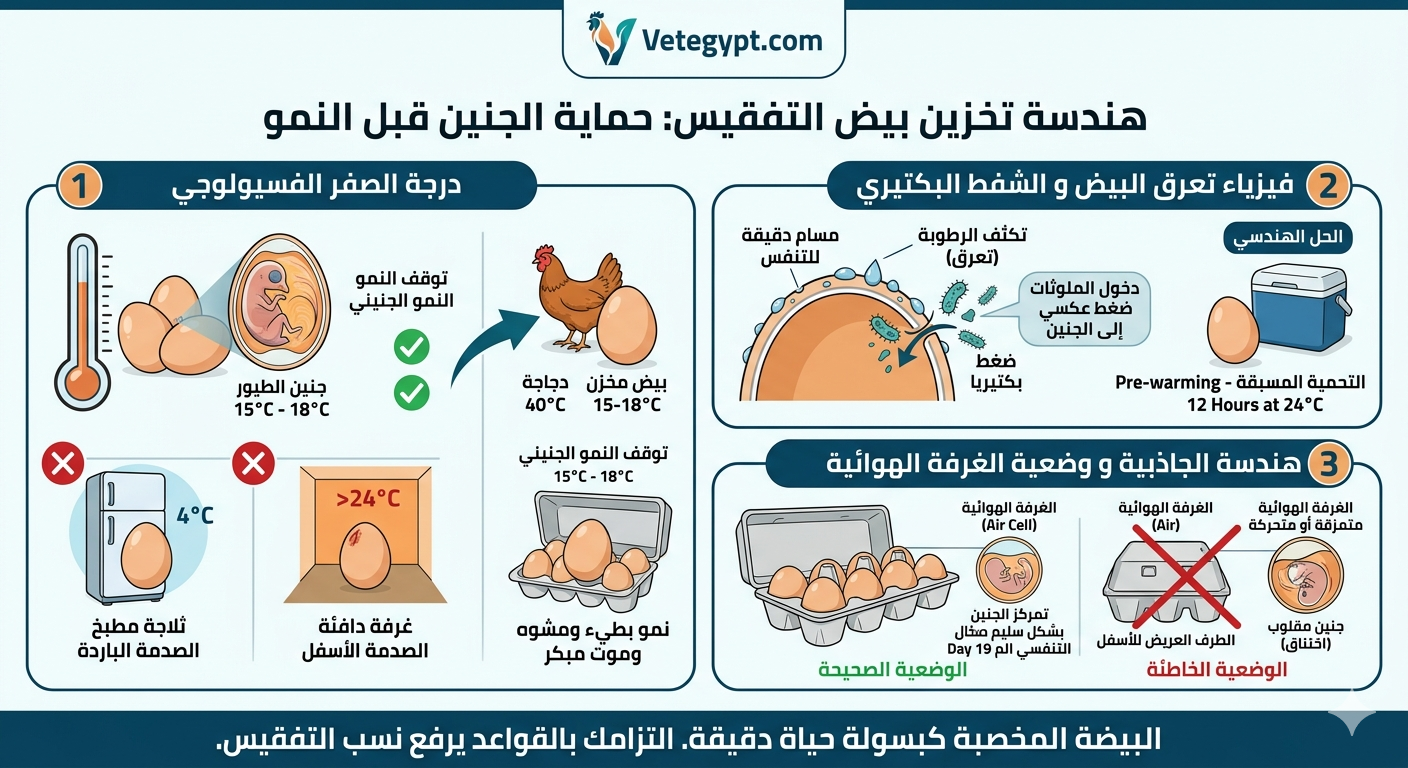
Engineering management for hatching egg storage: pre-incubation embryo protection protocol 🥚🌡️
hatching failures (premature embryo mortality or pecking failure) are often attributed to the efficiency of incubators, while biological facts in avian embryology indicate that “embryonic decline” often begins at the pre-incubation stage. The fertilized egg is not just an agricultural product, but rather a biological system in a state of “temporary dormancy,” requiring strict physical management to maintain its vitality.
The following are the engineering and biological protocols required to manage eggs before the hatching stage:
1. Thermal management and the law of “Physiological Zero” ❄️
Cell division of the embryo begins inside the chicken's body at a temperature of approximately 40°C. When the egg is laid, the embryo enters a state of “embryonic diapause”.
Technical risk: Storage at very low temperatures (such as food refrigerators, 4°C) causes fatal thermal shock to the cells. On the other hand, storage at temperatures exceeding 24°C stimulates slow and distorted molecular growth that leads to premature death.
Engineering standard: The storage temperature must be maintained between 15°C and 18°C. This range ensures that the fetus remains in a state of complete rest without consuming its vital reserves or being exposed to cellular damage.
2. Condensation dynamics and the phenomenon of “bacterial suction” (Egg Sweating) 💧🦠
The egg shell contains about 8,000 tiny pores dedicated to gas exchange.
Biological hazard: As this condensation evaporates inside the hatch, a “reverse osmotic pressure” is created that pulls bacteria and surface pollutants into the egg through the pores, causing the embryos to rot and the eggs to explode later.
Engineering solution (pre-warming): The eggs must be subjected to a thermal acclimatization phase at a temperature of 24°C for approximately 12 hours before the actual introduction into the incubator, to ensure drying of the shell and a gradual increase in the temperature of the embryo.
3. Position geometry and positioning of the “air chamber” (Spatial Orientation) 📐
The geometry of egg laying determines the movement path of the embryo on the 19th day of incubation.
Functional anatomy: The air chamber (Air Cell) is located at the broad pole of the egg. Instinctively, the fetus turns its head towards this pole to secure its first lung breath before the shell breaks.
Field application: Eggs should be stored with the pointed end down and the broad end up. Inverted storage regularly leads to the occurrence of “malposition”, which causes the chick to suffocate inside the egg due to its inability to reach the air chamber at the critical moment.
4️⃣ “Adhesion” mechanics and the importance of egg turning 🔄
Problem: The egg yolk tends to float upward; If it remains in a fixed position, it may touch the inner shell membrane and stick to it, which will lead to the death of the fetus as soon as development begins.
5️⃣ “Evaporation” and humidity coefficient (Humidity Control) 🌫️
The cortex is not just a shield, but rather a “filter” that allows gases and liquids to pass through.
Scientific standard: The humidity of the storage room should be between 70% to 80%. This osmotic pressure maintains the balance of fluids within the “life capsule.”
6️⃣ “Age” of the egg and the strength of the fetus (Storage Duration) ⏳
Time is the critical variable in the hatching equation.
The golden rule: The best hatchability rate is for eggs stored between 2 to 7 days.
Vital degradation: After the seventh day, the vitality of embryonic cells begins to decline by an approximate rate of 0.5% to 1% for each additional day. So, storing eggs for two weeks could mean losing half of the embryos before the journey even begins.
💡 Bonus pro tip:
“Avoid mechanical vibrations”: The fetus in a state of rest is very sensitive to violent vibrations that may tear the “protein ligaments” (chalazae) that hold the yolk in the center. Treat eggs as if they were pieces of rare crystal.
Products you may need
Browse all products of the All Products section
Related articles
- Wet or dry cat food: which is better?
- Early signs of cat illness: 10 signs not to ignore
- Cat vaccinations: complete schedule And its importance
This article is for general guidance and does not replace consulting a specialist veterinarian.